
How Governance Documents Connect, Support, and Remain Accountable to Enterprise Security Requirements
Introduction
An effective information security governance program requires more than a collection of Policies, Standards, Governance Instruments, and Procedures. These materials must be connected so that organizational requirements can be understood, implemented, maintained, and traced to their governing authority.
The G360 Policies, Standards & Governance Instruments (PSGI) Methodology addresses this challenge through Hierarchical Requirements Traceability: a structured approach for identifying and maintaining relationships among controlled governance documents.
Within PSGI, lower-level governance materials translate, elaborate upon, and support requirements established at higher levels. A Standard may support multiple Policies, a Governance Instrument may implement several Standards, and an operational Procedure may reference requirements from multiple governing documents.
These relationships are not necessarily one-to-one, nor must every document pass through each intermediate level of the governance hierarchy.
The purpose of traceability is to establish clear connections between enterprise security direction and operational implementation while supporting document ownership, change management, oversight, and accountability.
The Five-Level Governance Hierarchy and Traceability
The G360 Policies, Standards & Governance Instruments (PSGI) Methodology organizes information security governance into five related levels:
- Governance Model — Establishes enterprise information security authority, accountability, decision-making responsibilities, and oversight.
- Policy — Establishes mandatory enterprise security direction and high-level requirements.
- Standard — Defines specific mandatory security requirements and control expectations derived from applicable Policies.
- Governance Instruments — Provide supporting materials, methods, guidance, processes, and other instruments necessary to communicate, interpret, or operationalize security requirements. Individual Instruments become mandatory only when formally designated as such within their defined scope.
- Procedure — Provides operational instructions through which responsible business and technology functions implement applicable requirements.
These five levels operate within the overarching Information Security Management System (ISMS), which coordinates the enterprise’s information security program. The ISMS is not a sixth governance-document level.
Hierarchical Requirements Traceability establishes the relationships among these levels by identifying the higher-level governing documents from which each controlled document derives its requirements and authority.
A Standard may support requirements from several Policies. A Governance Instrument may relate to multiple Standards, and a Procedure may reference applicable Policies, Standards, and Governance Instruments.
Consequently, traceability does not require a separate document at every intervening level. Instead, each controlled document must identify its applicable governing references, enabling relationships to be followed upward through the hierarchy and supporting implementation and oversight.
Document Identification and Governing References
Each controlled PSGI governance document is assigned a unique, permanent document identifier. This identifier remains associated with the document throughout its lifecycle, while version information is maintained separately.
Permanent identifiers enable reliable referencing between governance documents, even as individual documents are reviewed, revised, and reapproved.
Except for the top-level Governance Model, each controlled PSGI document contains a standardized section identifying its applicable higher-level governing documents by their official reference numbers.
For example, a Vulnerability Management Standard may identify a Technology Security Policy as one of its governing documents. A supporting Vulnerability Management Process may subsequently reference that Standard, along with other applicable governing requirements.
These references establish the document’s position within the governance framework and allow reviewers to determine which higher-level requirements it supports.
Related supporting documents may be identified separately from governing documents, preserving the distinction between authoritative requirements and supplemental information.
Document-Level and Requirement-Level Traceability
The PSGI Methodology establishes document-level traceability as the baseline requirement. More detailed section-level or individual requirement-level relationships may be added when regulatory, contractual, audit, or risk considerations justify the additional granularity.
Operational Procedures may retain existing departmental identification conventions, provided they can be reliably cross-referenced to the PSGI governance framework.
The PSGI Document Register maintains document identities, versions, ownership, approvals, applicability, and hierarchical relationships, providing a central mechanism for maintaining and reviewing these connections.
An Illustrative Traceability Chain
The following example demonstrates how requirements can be traced from enterprise security direction through increasingly specific governance and operational documents.
| Governance Level | Illustrative Document | Reference |
|---|---|---|
| Policy | Technology Security Policy | POL-004 |
| Standard | Vulnerability Management Standard | STD-013 |
| Governance Instrument | Vulnerability Management Process | GI-028 |
| Procedure | IT Patching Procedure | IT-PRC-009 |
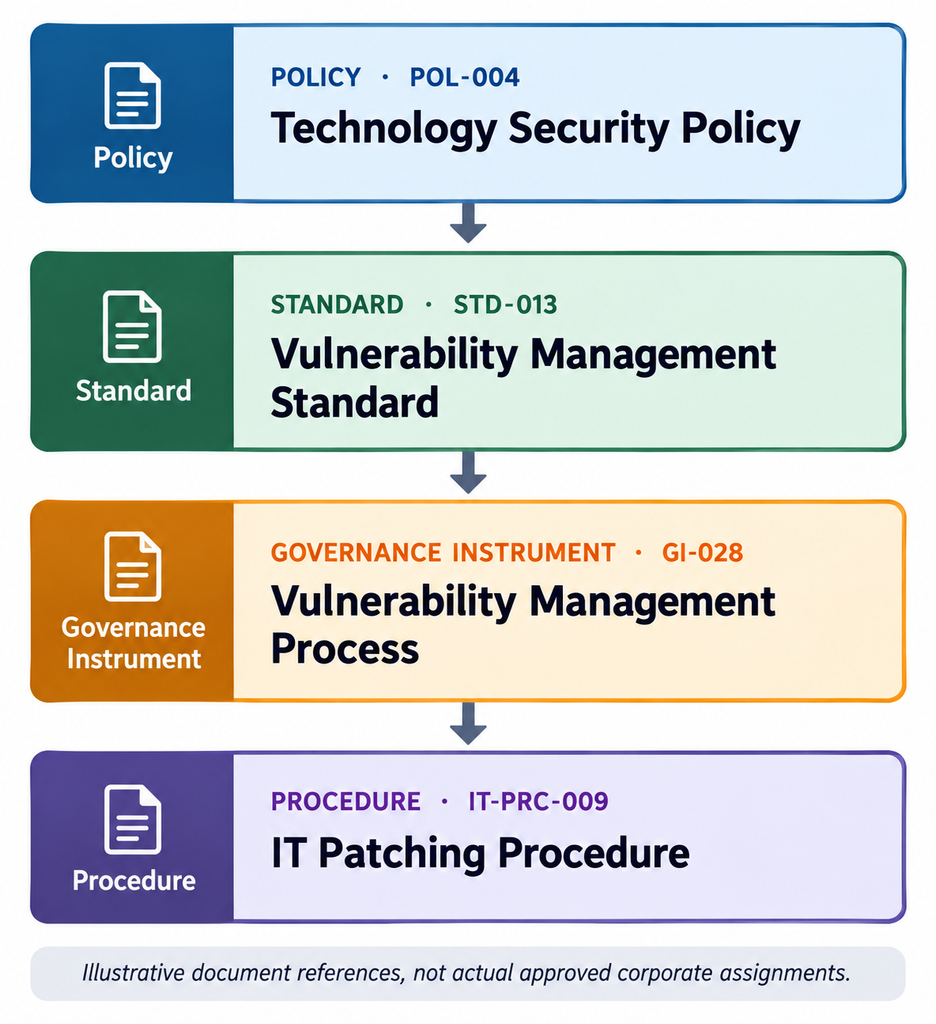
Important: These document titles and identifiers are illustrative examples. They do not represent actual approved corporate document assignments.
In this example, the Technology Security Policy establishes enterprise expectations for protecting technology resources.
The Vulnerability Management Standard translates relevant Policy requirements into specific, mandatory control expectations.
The Vulnerability Management Process supports implementation by describing how vulnerabilities are identified, evaluated, prioritized, and managed.
The IT Patching Procedure provides operational instructions for applying patches in accordance with applicable requirements.
The resulting relationships make it possible to trace an operational activity to its governing security requirements.
This example illustrates one possible chain. Actual PSGI relationships may be many-to-many, and an intervening document is not required at every level. A Procedure may reference multiple Standards, Policies, or Governance Instruments where applicable.
Many-to-Many Relationships and Change Impact Analysis
The PSGI Methodology recognizes that information security governance relationships are not necessarily linear or one-to-one.
A single Policy may establish requirements implemented through several Standards. Conversely, a Standard may address requirements established by multiple Policies.
Governance Instruments may support several Standards, while operational Procedures may implement requirements from multiple governing documents. These relationships create an interconnected structure in which documents can have several governing references and support multiple operational activities.
Change Impact Analysis
These relationships are especially important when a governance document is revised, replaced, or withdrawn.
For example, a change to a Technology Security Policy may require examination of several related Standards, Governance Instruments, and operational Procedures to determine whether their requirements or implementation instructions remain appropriate.
The PSGI Document Register provides the documented relationships needed to identify potentially affected materials and their responsible owners.
A structured change impact review may include:
- Identifying the governing document being changed.
- Locating documents that reference or depend upon it.
- Determining whether existing requirements remain consistent with the revised direction.
- Consulting affected document owners and business Entities.
- Identifying necessary revisions, approvals, and implementation activities.
- Updating document versions, governing references, and associated records.
This approach allows changes in enterprise security direction to be examined for downstream implications rather than treated as isolated document revisions.
Traceability does not require every governance document to reference every related document. Its purpose is to maintain reliable governing relationships that support accountability, consistency, change management, and oversight.
The PSGI Document Register and Traceability Maintenance
The PSGI Document Register serves as the central administrative record for controlled governance documents and their relationships within the information security governance hierarchy.
While the PSGI Matrix provides a visual reference for locating and understanding governance materials, the Document Register maintains the detailed information necessary to control those materials throughout their lifecycle.
For each controlled document, the Register maintains relevant information concerning:
- Document identification: Permanent document identifier, official title, and current version.
- Ownership: Designated document owner and responsible organizational function.
- Approval: Designated approval authority, approval status, and associated records.
- Entity applicability: The business Entities, functions, or operations to which the document applies.
- Governing references: Applicable higher-level governance documents identified by their permanent reference numbers.
- Mandatory status: Where applicable, the formal designation indicating whether an individual Governance Instrument establishes binding requirements.
- Maintenance: Review dates, revision status, and other document-control information.
The Register supports traceability by recording relationships between controlled documents. These relationships enable governance administrators and document owners to identify applicable governing requirements and determine which documents may be affected by changes elsewhere in the hierarchy.
Ongoing Traceability Maintenance
Traceability must be maintained as part of the recurring PSGI Governance and Maintenance Process.
When documents are introduced, revised, replaced, or withdrawn, their governing references and corresponding Register entries must be reviewed and updated as appropriate.
Document owners remain responsible for maintaining their assigned materials, while designated governance authorities oversee approvals and consistency with enterprise requirements.
The PSGI Document Register therefore supports more than document inventory. It provides an administrative foundation for maintaining the integrity, accountability, and continuing relevance of the enterprise’s information security governance documentation.
The Register is distinct from the PSGI Exception Register, which records authorized deviations, risk considerations, remediation deadlines, formal reviews, and required escalation activities.
Practical Value and Conclusion
Hierarchical Requirements Traceability provides a means of connecting enterprise information security direction with the governance documents and operational activities through which that direction is implemented.
By maintaining identifiable relationships among Policies, Standards, Governance Instruments, and Procedures, organizations can better understand how requirements are derived, where they apply, who is responsible for maintaining them, and which materials may require review when governing requirements change.
The approach provides value to several organizational audiences:
- Executive leadership and governance authorities gain greater visibility into how enterprise security expectations are translated into documented requirements and operational responsibilities.
- Information Security leadership can identify governance relationships, coordinate document maintenance, and evaluate the implications of proposed changes.
- Document owners and operational managers can identify applicable governing requirements and maintain consistency between their assigned documents and enterprise direction.
- Risk, compliance, and audit functions can use documented relationships to support reviews of governance coverage, accountability, and implementation.
Within the broader G360 Policies, Standards & Governance Instruments (PSGI) Methodology, hierarchical traceability complements the Governance Triangle, PSGI Matrix, Document Register, Exception Register, and recurring Governance and Maintenance Process.
Together, these components provide a coordinated approach to organizing, connecting, maintaining, and overseeing information security governance materials.
The objective is not to create an unnecessarily complex documentation system. It is to establish clear, reliable relationships that help organizations translate enterprise security expectations into accountable operational practice.